Showing posts with label rosetta stone. Show all posts

Saturday, June 22, 2013

rosetta stone follow-up

i gave some impressions about the rosetta stone software last month. I'd had some pretty positive things to say about it, despite most other peoples' opinions being "meh". Most notably, the people who weren't fond of it were the ones that were most familiar with language learning. But they'd also said that the software's best feature, live video sessions with a tutor, was a redeeming factor. I'd had yet to try it at the time of review, but I've tried it now, having been motivated by the 3-month expiration period. The free period had about 2 days left when I finally used it. You keep the software otherwise after the expiration, and you don't lose any features, but the tutor sessions have to be paid for. After trying it out, I have to agree that it does make the package much more interesting, and should be a definite point of consideration for new buyers. I just wish I'd used it sooner.

Apparently you're supposed to keep your clothes on. I lost points for that.

I'm still in the middle of the first study unit (of 12), so the lesson was still pretty simple; the tutor session corresponds to how much of the normal software you've done. I shared the session with 2 other students, and each of us were required to have microphones. There is no point-and-click answering the way there is with the normal lessons. The instructor has a Powerpoint-type presentation that they're able to draw on, kind of like what you'd see on ESPN when they reconstruct football plays. They also have their own video feed, which comes in handy when they want to help you by gesturing. They'll verbally ask you questions about the picture, draw arrows pointing to the object they want you to name, and address you by name so you know when it's your turn to answer.

It's not radically different from the software's normal offline lessons, really. But it's much more challenging, and I feel like you can probably learn a lot more from it. Not because the lessons are any better, but because human interaction is a better teacher than study alone. Studying the language on paper allows you a lot of time to come up with answers, study the questions you are being asked, and the computer can wait on you indefinitely to come up with the answer. My speed when going through it normally is akin to counting on fingers, and does not come across as conversational at all. I wouldn't have even have known that, had I not frozen the first time the tutor asked me a question. 

It's a deer in headlights.

I just wasn't familiar with hearing Japanese in anything but a perfect, over-enunciated tone. Also, I wasn't used to having to recall the language "cold", and immediately, before. Usually, when you're studying, you've been doing the same lesson for a while, and so much of your language skill is just habituation and short-term memory. You also have all the time you need to respond. It's a whole different beast to have to produce your cumulative knowledge of the subject, on command. It really whipped my brain into a frenzy, and I could actually feel it doing real work for the first time since college. I wager this is a much better way for you to learn to speak, as it helps you make a connection between ideas and the words for them, so that they can be produced together quickly. In my session, despite the months of work I've done offline, I found myself constantly grasping for words and taking long pauses. And I'm actually glad that I found that out. While it was mildly embarrassing to find out that I was nowhere near as good at this as I'd thought, at least I know now and can work to get better. I never would have found that out on my own.

The instructor herself was incredibly patient, but had used a word here or there that I wasn't familiar with; either I had forgotten, or we hadn't been taught the words yet. I'm a person who panics easily, so this was part of the reason I was freezing up initially. I'd expected this to happen, because I knew that they only use the language you are learning, and do not speak to you in English. It sucked to be caught off guard, but it's not like the instructor has a choice, and honestly, the goal is to make the student able to speak fluently, right? If you visit Japan or any other country whose language you are learning, nobody's going to phrase the questions like Rosetta Stone out of coincidence, so preparing for that early is probably best. After a few questions I started to better understand what she was saying, and wound up performing pretty well.

And tomorrow my Unicorn and I will visit the land of Oz. 
So yes, the different mechanics of learning offered by human conversation, in addition to their ability to correct you real-time, make a huge difference in your ability to learn. Rather, it sharpens your existing knowledge of the language and gives you an extra level of elasticity. Your responses should become snappier as a result, and vocabulary should be more immediately accessible. If you're shopping around for a way to learn a new language, this is definitely an advantage that Rosetta Stone offers, if you're too cheap for classes like I am. 

Tuesday, May 21, 2013

rosetta stone


i love a lot of Japanese stuff, but I'm far from being an honest to goodness Japan-o-phile. Siam Shade is one of my favorite bands, Ghost in the Shell is one of my favorite movies, and DBZ is DBZ. But I've never enjoyed trying sushi, I can't use chopsticks worth a damn, and I usually have to be dragged into watching anime (even if I usually wind up liking it). I'd thought about travelling there semi-long-term when I was still in school, but the planets didn't line up right for that to happen. I still harbor hopes of one day getting my ass across the Pacific, in a vacation context at the very least.

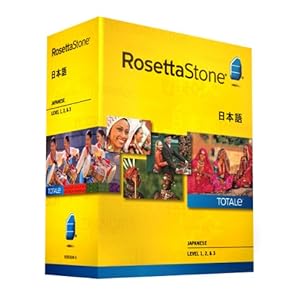
Because I hate the idea of having to constantly ask "do you speak English?", I picked up a copy of the Rosetta Stone for Japanese. The package costs about what I'd call fair for this type of thing, but it's not exactly a tiny investment, so I'd read some reviews first just to see what others thought. The purchase would be a huge roll of the dice, apparently, as reviews were split at best, with negative reviews mostly coming from people who identified as polyglots. So, the people who are most familiar with language-learning hate it the most. Not a good sign.

I covered my eyes with my palm and clicked "Submit Order", because I figured if I didn't go this route, I'd be taking classes anyway. And one or two semesters cost the same as Rosetta Stone, so it's not a huge loss in relative terms. I'm not very far in, but can probably give some first impressions now. I can't tell if it's a viable substitute for real classes just yet, but I do have 2 years of Spanish training (courtesy of public education) to compare it to. Donde esta la biblioteca?

So since I'm basically fluent in Spanish, I'll be able to tell you if Rosetta Stone helps you achieve this same expert level of proficiency. First, let's get into the nuts and bolts of how it teaches. It uses some mic input for pronunciation courses, but for the most part the lessons are carried out by way of multiple choice questions, communicated entirely with pictures. They do include the text for your options, but for the most part you'll match audio to it's corresponding answer. So, you'll hear the word for apple which is "ringo", and be asked to pick the picture of an apple.

Beatlemania knows no bounds I guess. 
Once it knows you have a few basic vocabulary words down, it'll teach you some basic sentences, and it follows this type of progression throughout. It'll take what you have confirmed to know, and throw something a little bit new at you, and let you do the deconstructing as far as what the new element is, what it means, and what it "does". For instance, if you know the words for "apple", "to eat" and "boy", it'll then show you how to say "the boy is eating the apple". It's a small enough change that you can figure out the grammar of the sentence by separating it from the nouns and verb. Depending on your outlook on this sort of thing, playing detective can be a fun and engaging way to learn, or it can be a juvenile waste of your time. You pick.

The progression itself, consequently, is slow. For people who have learned more than one language before, it can be kind of frustrating I've heard, as they prefer having the expediency of translation-based learning. Rosetta Stone's learning model, famously, is to "learn like an infant", using only audio and then associating it with pictures. Because you have to be introduced to every word individually, it does take some time. You don't have a spreadsheet of words and their equivalents in English to study, unless you document one as you go (which I've started doing).

I've been dicking around with it for 2 months, and I only know how to say things like  "Is she a doctor?", "The man is eating a sandwich", and "The sky is blue". To be fair, each of those sentences serve different functions (if you noticed), and all required their own portion of dedicated study. My usage of it has also been very minimal, so it might be impressive that it's taught me so much with so little time put in. There are 12 units of study (3 levels, 4 units each), and I've only finished half of one.

If there are any drawbacks to the method that I've found so far, one is that the pictures can sometimes lack clarity in terms of what it's trying to show you. For instance, when the program was trying to teach me the difference between "I have the book" and "you have the book", it used pictures with 2 people touching the same book. Granted, one party was holding and the other was touching, but it really would have helped if only one person had been holding it, seeing as how the picture is all I really have to go on. If 2 people are touching it, then that's what I'm going to think it means. It's a problem that came up more than I'd expected, and could have easily have been solved with small tweaks.

Is this "Dog" or  is this "Car"? Neither; it's "Parallel Park"

It also comes with a companion MP3 CD, which should play on just about everything. It's a pretty nice review tool that you can use to brush up on the last thing you learned so that you don't have to backtrack next time you load the software. Because it only uses the native language, it can't really teach you anything new (think about it), but hey it's better than nothing. Like learning in a typical classroom environment, you have to hear things multiple times before they stick, and this can help speed up the process. The universal MP3 format makes it so that you can take it just about anywhere you go, on your chosen device. I personally just throw the CD into my car's player and listen to it on my way to and from work. The lessons are in "repeat after me" format, so I sometimes look crazy when I'm driving.


I had noticed that there's a 3 month period of online services included, of which I have yet to avail myself. I have about 1 month left, and I hear the package's sweetest element, video sessions with a live teacher, are part of that. I should probably make a point of using that before it expires before I report back. Polyglots say that that's the most interesting and useful feature, so I'll do my best to see if I can make that happen. For now, it comes pretty highly recommended by me. The jury is still out on long-term results or success, but for now I can at least say I've had legitimate fun using it, and have gained some rudimentary language skill. More as details develop. For now, this is the extent of my skill: The boy is eating the bread - "Otokonoko wa pan o tabete imasu". So I'm about halfway to fluency.

Can't find it?